For many businesses, commercial refrigeration is not just another piece of equipment—it is the backbone of daily operations. Grocery stores, convenience stores, restaurants, floral shops, pharmacies, and specialty retailers all depend on refrigeration systems to protect inventory, maintain product quality, and serve customers. However, these systems also represent one of the largest ongoing operating expenses in a commercial building.
As utility costs continue to rise, business owners are searching for practical ways to reduce overhead without sacrificing performance. One of the most effective solutions is investing in energy-efficient refrigeration equipment. Combined with modern energy management systems, today’s high-efficiency refrigerators can significantly reduce energy consumption while improving reliability and operational control.
Companies like Ty Construction Company recognize that creating efficient commercial spaces involves more than construction alone. It also means helping businesses incorporate technologies and equipment that support long-term savings and performance.
If your current refrigeration equipment is driving up energy bills, understanding the benefits of energy-efficient refrigerators can help you make smarter decisions for your business.
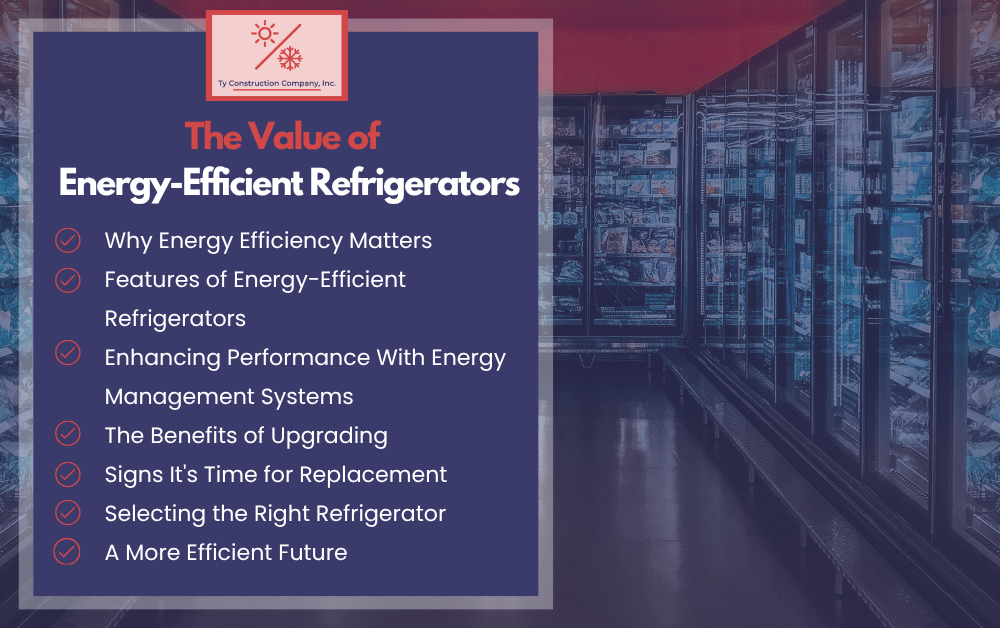
Why Energy Efficiency Matters
Commercial refrigerators operate continuously. Unlike lighting systems that can be switched off overnight or office equipment that remains idle after business hours, refrigeration equipment works 24 hours a day, 365 days a year.
Because these systems never truly stop running, even small efficiency improvements can have a substantial impact on annual operating costs.
Older refrigeration equipment often consumes significantly more electricity than newer models. Components wear down over time, insulation loses effectiveness, and outdated technology struggles to maintain optimal performance. As a result, aging systems frequently use more energy than necessary while delivering inconsistent cooling.
Energy-efficient refrigerators are specifically designed to address these challenges. Manufacturers now incorporate advanced technologies that allow equipment to maintain proper temperatures while consuming less power.
When paired with modern energy management systems, businesses gain even greater control over refrigeration performance and energy usage. Instead of simply running equipment until something breaks, owners can monitor performance, identify inefficiencies, and make data-driven decisions that improve profitability.
For businesses operating multiple refrigeration units, the savings potential can be substantial.
Features of Energy-Efficient Refrigerators
At first glance, many commercial refrigerators look similar. The differences become apparent when you examine the technologies working behind the scenes.
Energy-efficient units are engineered to maximize cooling performance while minimizing wasted energy.
Several innovations contribute to improved efficiency.
Advanced Compressor Technology
The compressor is often the most energy-intensive component in a refrigeration system. Newer refrigerators frequently utilize variable-speed compressors that adjust output based on cooling demand.
Rather than operating at full capacity all the time, these compressors can increase or decrease activity as conditions change. This reduces unnecessary energy consumption and helps maintain more stable temperatures.
Improved Insulation
Modern insulation materials significantly reduce heat transfer between refrigerated spaces and surrounding environments.
Better insulation means less cold air escapes and less warm air enters the unit. As a result, the refrigeration system does not have to work as hard to maintain desired temperatures.
High-Efficiency Fans and Motors
Many older refrigerators use traditional fan motors that consume considerable energy. Today’s energy-efficient equipment often features electronically commutated motors (ECMs), which require less electricity while delivering reliable airflow.
These motors not only improve efficiency but can also contribute to quieter operation.
Smart Controls
Built-in digital controls allow equipment to respond more effectively to changing conditions. Some systems automatically adjust performance during slower business hours or optimize cooling cycles based on actual demand.
This is where energy management systems become especially valuable, providing additional monitoring and control capabilities that help maximize efficiency.
Enhancing Performance With Energy Management Systems
While energy-efficient refrigerators provide immediate benefits, their full potential is often realized when they work alongside modern energy management systems.
Many business owners assume that installing efficient equipment alone is enough. In reality, monitoring and optimization play an equally important role in reducing energy costs.
Energy management systems allow owners to see exactly how refrigeration equipment is performing throughout the day.
These systems can track:
- Energy consumption patterns
- Temperature fluctuations
- Compressor runtime
- Equipment alarms and faults
- Performance trends over time
Instead of relying on guesswork, managers gain access to real-time information that helps identify opportunities for improvement.
For example, an energy management system may reveal that a refrigerator is cycling more frequently than expected. This could indicate a maintenance issue, a damaged door gasket, or an improper temperature setting. Identifying the problem early can prevent larger issues and reduce unnecessary energy use.
The combination of efficient equipment and intelligent monitoring creates a more proactive approach to refrigeration management.
Rather than reacting to problems after they occur, businesses can address inefficiencies before they impact operations.
The Benefits of Upgrading
One of the most common reasons businesses hesitate to upgrade refrigeration equipment is the initial investment. However, focusing solely on purchase price can overlook the long-term financial advantages.
Energy-efficient refrigerators often generate savings in several different areas.
Lower Utility Costs
The most obvious benefit is reduced electricity consumption. Since refrigeration equipment operates continuously, efficiency improvements can produce meaningful reductions in monthly utility bills.
Over several years, these savings can offset a significant portion of the equipment’s purchase cost.
Reduced Repair Frequency
Older refrigeration systems frequently require more maintenance and repairs. Components experience greater stress, and breakdowns become increasingly common as equipment ages.
Newer systems often operate more reliably and include advanced diagnostic capabilities that support proactive maintenance.
Longer Equipment Lifespan
Because energy-efficient refrigerators are designed to operate more effectively, critical components may experience less wear and tear.
This can extend the useful life of the equipment and improve return on investment.
Better Inventory Protection
Temperature consistency is critical for protecting refrigerated products. Fluctuations can compromise quality, shorten shelf life, or even result in spoilage.
Advanced controls and energy management systems help maintain stable temperatures, reducing the risk of inventory loss and associated financial impacts.
For many businesses, protecting valuable inventory is just as important as lowering utility costs.
Signs It’s Time for Replacement
Many business owners continue using refrigeration equipment long after efficiency has begun to decline. While regular maintenance can help extend equipment life, there comes a point when replacement becomes the more cost-effective option.
Some common warning signs include:
- Rising energy bills without a clear explanation
- Frequent service calls and repair expenses
- Inconsistent temperatures inside units
- Excessive compressor cycling
- Difficulty maintaining food safety standards
If several of these issues are occurring simultaneously, upgrading to energy-efficient equipment may provide significant operational benefits.
An evaluation of your current refrigeration system can help determine whether replacement is the best path forward.
In many cases, the ongoing cost of operating inefficient equipment exceeds the investment required for modern alternatives.
Selecting the Right Refrigerator
Not every commercial refrigerator is suitable for every application. Determining the proper equipment requires careful consideration of your operational needs.
Before making a purchase, consider factors such as storage capacity, product types, traffic patterns, and environmental conditions.
Look for features that support both efficiency and performance, including:
- High-efficiency compressors
- Advanced digital controls
- Quality insulation materials
- ENERGY STAR® certification when available
- Compatibility with energy management systems
It is also important to think beyond immediate needs. Choosing equipment with room for future growth can prevent costly replacements later.
Working with experienced commercial professionals can help ensure that refrigeration systems are properly sized and configured for your specific facility.
A well-planned installation often delivers better performance than simply purchasing the most expensive unit available.
A More Efficient Future
Energy costs are unlikely to decrease in the coming years. Businesses that prioritize efficiency today will be better positioned to control expenses and remain competitive in the future.
Energy-efficient refrigerators represent one of the most practical opportunities for reducing operational costs in facilities that rely heavily on refrigeration. When integrated with modern energy management systems, these units provide valuable insights that help maximize performance, reduce waste, and improve overall operational efficiency.
The result is a refrigeration strategy that supports both short-term savings and long-term business growth.
Conclusion
Commercial refrigeration is one of the most critical—and costly—systems in many businesses. Investing in energy-efficient refrigerators can help reduce utility expenses, improve equipment reliability, protect inventory, and create a more sustainable operation. When combined with advanced energy management systems, businesses gain greater visibility into performance and more opportunities to optimize energy usage.
If your current refrigeration equipment is increasing operating costs or struggling to meet performance expectations, now may be the ideal time to explore energy-efficient upgrades. The team at Ty Construction Company can help you evaluate solutions that improve efficiency, reduce long-term expenses, and support your business’s success. Contact Ty Construction Company today to learn how smarter refrigeration strategies can benefit your commercial facility.